NJECPAC & NJ-IEC Partnering to Protect You And Your Business

My photo
New Jersey, United States
NJECPAC is a Continuing Political Committee (CPC). A CPC is any group of two or more persons acting jointly, or any corporation, partnership, or any other incorporated or unincorporated association, civic association or other organization, which in any calendar year contributes to aid or promote the candidacy of an individual, or the candidacies of individuals, for elective public office, or the passage or defeat of a public question or public questions, lobby for the passage or defeat of certain legislative bills introduced in the NJ Legislature in accordance with N.J.S.A. 19:44A-8(b). A CPC is frequently referred to as Political Action Committee (PAC). The NJECPAC was formed to provide funding for legislative initiatives of its members and its member organizations representing the interests of Electrical Contractors, Small Businesses and Taxpayers throughout the State of New Jersey.

Young Voices Without A Vote

Recent NJECPAC Headlines

Our National Debt

Thank You Soldier

Showing posts with label HR 3590. Show all posts

Friday, April 19, 2013

Insurers Warn of Obamacare-Induced Sticker Shock


Health Actuaries: Obamacare Rates Expected To Soar


Few aspects of the Affordable Care Act are more critical to its success than affordability, but in recent weeks experts have predicted costs for some health plans could soar next year.
Health law supporters are pushing back noting close ties between the actuaries making the forecasts and an insurance industry that has been complaining about taxes and other factors it says will lead to rate shock for consumers. The laws supporters ignore one elementary and simple fact. When costs rise for insurers those costs are passed along to consumers in the form of higher premiums. Read More

There is some good news for Electrical Contractors and some Businesses
Electrical Contractors and Businesses that are partnered with them have an opportunity for significant savings on their health care benefits. NJECPAC Partner Association New Jersey IEC has joined Association Master Trust (AMT). AMT is an unique not for profit multi-Association Health Benefits Plan offering a multitude of Medical and Dental plans at group rates. 
Even one person Companies that would not otherwise qualify for group rates under NJ Law are eligible for Group Rates on their Health Insurance through AMT. AMT utilizes the Blue Cross Provider Network and includes 'Blue Card' which includes the Blue Cross World Wide Network of Service Providers. 
AMT for Electrical Contractors is available exclusively through New Jersey IEC. Participants in AMT have seen Group plan savings in the hundreds and even thousands of dollars.  
For more information visit www.NJ-IEC.org or contact New Jersey Independent Electrical Contractors by phone at (973) 467-0027, fax: (973) 467-4066, email: executivedirector@nj-iec.org
   Follow NJECPAC on ~ Twitter ~ Facebook ~ YouTube ~ LinkedIn 


Saturday, March 23, 2013

Small Businesses Misunderstand Health Care Mandate

A new survey shows that many small businesses misunderstand the employer mandate of the Affordable Care Act, which affects only businesses with the equivalent of at least 50 full-time workers. More than half of the 259 survey respondents -- all of whom do not meet the mandate threshold -- mistakenly thought they would be subject to the mandate. Read More On Bloomberg Businessweek | Read More At Entrepreneur online

The mandate is just the beginning of what is ahead for small businesses. Just one repercussion is every business will have to pay $63 per year for each employee and employee dependent on their company health care plan for each of the next three years. This is to pay for preexisting conditions that are now mandated to be covered under the law. 

The question remains how could these businesses not know how this law will effect them. One reason is many small business owners could not be bothered to belong to a credible Business Association within their field that would have provided them with National Regulatory and Legislative info important to them and their businesses. That is really the only viable explanation how these business owners could possibly be unaware of what Obamacare would mean to them and their businesses. 

They chose not to belong to save a few bucks on Association Dues, or perhaps because they believe they don't have the time or they believe that they do not need to belong to a National Association and prefer to belong to their local social club. They are full of Excuses, we have heard them all but now, they will pay for their isolation. Unlike Business Associations, Government laws and regulations offer NO Return on Investment. 

In addition to offering Association Group Healthcare for Electrical Contractors, The only Electrical Contractors Association in New Jersey offering State and National Regulatory and Legislative Affairs exclusively for Merit Shop Electrical Contractors is New Jersey IEC. 
New Jersey IEC has retained a Lobbyist in New Jersey and is represented by IEC's Vice President of Government Affairs on Staff at the IEC National Office in Alexandria Virginia. 

NJECPAC has partnered with New Jersey IEC to provide the most important of the myriad of Regulations and Legislative mandates effecting Electrical Contractors to NJECPAC member Organizations. 

Find more information on New Jersey IEC and Association Group Health Benefits for Electrical Contractors Here

Follow NJECPAC on Twitter ~ Facebook ~ YouTube ~ LinkedIn 


Monday, September 24, 2012

Study Confirms Most Employers Plan To Keep Health Coverage

The latest health care survey conducted by consulting firm Towers Watson has found that the vast majority (88%) of the 440 midsize to large companies surveyed claimed that they had no plans to drop health care coverage in the near future. Among other findings, the Towers Watson survey noted that employers did plan to take a number of steps to control projected health care cost increases and to avoid having to pay the 40% excise tax on high cost (“Cadillac”) health plans in 2018. A majority of employers (58%) expect that they will trigger the excise tax in 2018 if they do not make changes to their current benefit strategy. As a result, 83% of employers are planning to take steps to control their costs to avoid the tax.

Notable survey results include the following:

  • The number of employers stating that they would continue providing health coverage for their active employees increased 17% over last year’s survey.
  • More than three-quarters (77%) view health care benefits as core to their employee value proposition over the next several years, and more than one-third of companies will examine their health care benefits in a total rewards framework by 2013.
  • The cost of providing health coverage is projected to increase by 5.3% in 2013, down from the 5.9% projected increase for 2012.
  • The total cost of providing coverage is estimated to be $11,507 per employee in 2013.
  • To control costs, responding employers claimed that they will either adopt or continue to provide account-based health plans (ABHPs), which are plans “with a deductible offered together with a personal account (health savings account or health reimbursement arrangement) that can be used to pay a portion of the medical expense not paid by the plan.” According to the survey, by the year 2015, 80% of employers intend to offer an ABHP, up from 61% in 2013.
  • Companies are also considering other steps to reduce costs, including changing plan options (63%), significantly reducing subsidization of coverage for spouses and dependents (38%), and using spousal waivers or surcharges (29%). Additionally, 13% plan to increase their employees’ share of health care premiums in 2013 by five percentage points or more, while 42% plan to increase employees’ share by one to five percentage points.
  • Seventeen percent of responding employers claimed that they plan to offer telemedicine services by the year 2013, with another 27% considering doing so by 2014 or 2015.
  • A greater number of employers responded this year that they were “very likely” to discontinue sponsoring health plans for retirees in 2014 or 2015. Many employers are also considering reducing the subsidization of coverage for their employees’ spouses and dependents, and passing along a greater percentage of the increased costs to their employees.
A recently-released report issued by the Government Accountability Office (GAO) examined a number of studies on the ACA’s impact on employer-sponsored coverage. Read More Here

Friday, September 21, 2012

Don’t Play & Pay: Navigating Employer Health Coverage Mandate

On Friday, August 31, the Internal Revenue Service (IRS) issued guidance regarding the application of the employer-sponsored health coverage mandate. Employers need to begin planning for these rules as soon as possible. While the employer coverage mandate itself does not apply until 2014, it may be necessary to begin tracking the hours of employees as soon as this October in order to facilitate compliance.
The Play or Pay Rules
The employer-sponsored health coverage mandate is designed to require non exempt employers to either provide employees with adequate and affordable health coverage or to require those employers to pay certain penalties for their failure to do so. Specifically, penalties are triggered if:
  • (1) An employer fails to offer all of its “full-time employees” the opportunity to enroll in an employer-sponsored health plan; or (2) the employer-sponsored health plan offered to “full-time employees” is “unaffordable” or fails to provide “minimum value”; AND
  • Any employee impacted by such a failure purchases individual health insurance coverage through a State-based or Federally-facilitated Exchange and qualifies for a subsidy.
Failure to Provide Coverage
Employers who fail to provide coverage to all of their “full-time employees” are subject to a penalty of $2,000 per year (assessed on a monthly basis) multiplied by their total “full- time employee” count. For employers that provide health coverage, the challenge with respect to this rule is identifying all of their “full-time employees”—and making sure all such employees are offered coverage. In the event that even one “full-time employee” is not offered coverage and subsequently attains subsidized coverage through an exchange, the penalty is applied to all “full-time employees.” Thus, with respect to any employees who do receive employer-sponsored coverage, the employer could end up “playing” and “paying.” Read More Here
 Follow NJECPAC on Twitter,  Facebook, YouTube, LinkedIn 
Explore More at NJECPAC

Monday, April 23, 2012

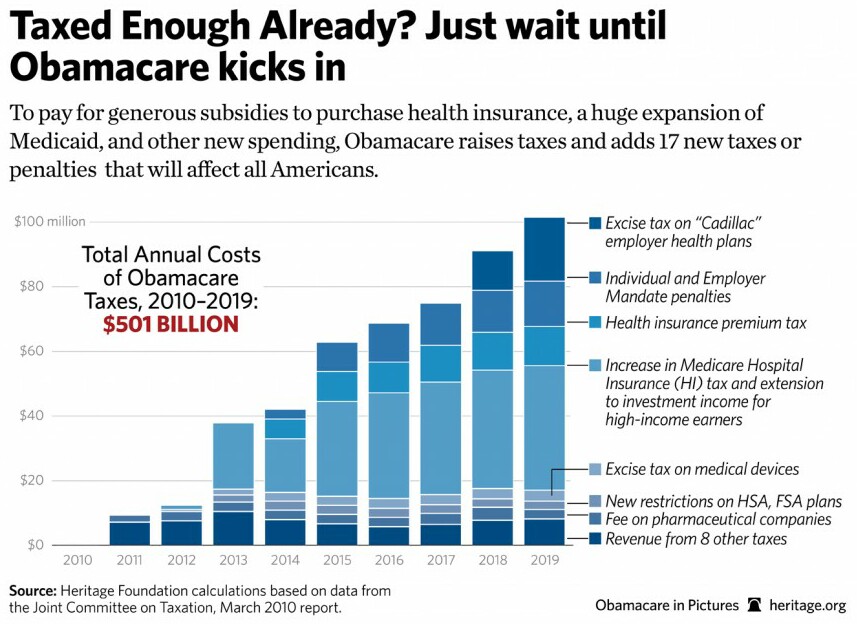
Top 10 Most Expensive Obamacare Taxes and Fees


Now that tax day has passed and we will be working for months to come to pay this years taxes, we are reminded of how big the federal government has become and how Obamacare is on track to makes things a lot worse.
The President’s health law will be partially paid for by tax increases and the creation of new taxes. When the law was passed, the Joint Committee on Taxation estimated that its tax hikes would total $502 billion over the next 10 years. 
However, most of the new, higher taxes were intentionally designed to kick in later in the decade producing an deliberate false cost number. When the full law is implemented, taxpayers will be paying far more than the either knowingly or ignorantly false estimated.


A new study by the Joint Economic Committee (JEC) has revealed that Obamacare will impose higher taxes totaling $4 trillion (That's $4,000,000,000,000) between now and 2035, with the most substantial hits falling on the shoulders of working Americans. That works out to more than $1.7 trillion over a decade, more than triple the original 10-year score.

The following are only 10 of Obamacare’s 18 tax increases. Hospital Insurance Tax - Mandate Penalties - Health Insurance Provider Fee - “Cadillac” Tax - Prescription Drug Fees - Ethanol Tax - Medical Device Tax - Business Regulation Costs - Reducing Medical Deductions - FSA Limits. The economic damage from these tax hikes is one of many reasons to repeal Obamacare and pass legislation that would sensibly reform the health care system. Read More


Follow NJECPAC on Twitter,  Facebook, YouTube, LinkedIn 

Thursday, March 29, 2012

Supreme Court Now Poised To Rule On Constitutionality Of The Affordable Care Act

Justices' questions suggest skepticism about health care law


The questions asked by U.S. Supreme Court justices Tuesday during arguments on the constitutionality of the 2010 health care law suggest that a majority on the court may have serious doubts about whether the law can be upheld. Yesterday, justices will considered whether parts of the law can remain in place if the court strikes down the requirement that individuals carry health insurance.


Realistically, In the case before them it is not the job of the Supreme court to decide or even take into account the sustainability of the rest of the Law. The case before them is the Constitutionality of the Mandate to purchase Health Insurance or be penalized. What happens to the law if they decide the Mandate is Unconstitutional is not their role in the case.


Justices on the asked highly nuanced questions over the three straight days of oral arguments. It seemed that some are torn on whether it would be more of a break from past cases to strike down the so-called individual mandate to obtain insurance or to uphold it. What past cases have to do with if a law is constitutional or not is beyond me.


They were aggressive in their questioning of both sides, and fired off hard-hitting questions about the limits of the federal government's power and whether it could even extend to requiring eating broccoli and buying gym memberships or cars, and rightfully so.


The main stream media defined Conservative Justices took aim at the insurance mandate, while the so called liberal justices supported it. Which is to be expected. 


We question the Medias defining a Supreme Court Justice as Conservative or Liberal, They are there to rule on the law and constitutionality of various issues. It is not their role to impose their assumed political ideology 


A ruling on the law is expected in late June. Read More

Wednesday, January 18, 2012

Small Business Waiting on Mandates in Obama's Health Care Law

Faced with higher premiums again in the year ahead, many business owners have found themselves in a holding pattern over health care. 

They're increasingly concerned about the rising costs of health care plans and the impact that health care reform will have on their businesses, and unsure whether they should make any changes in their current plan until they have a better understanding of the law and their options. More


With the constitutionality of H.R.3590 The Affordable Care Act scheduled to be heard by the Supreme Court, small-business owners are taking a wait-and-see approach to changing their health plans and or plan benefits. Rising premium costs have caused small businesses to begin to choose lesser plans with reduced benefits and or increase the percentage that their employees must contribute to their health care plan in 2012. More


Follow NJECPAC on Twitter,  Facebook, YouTube, LinkedIn 

Wednesday, November 16, 2011

US Supreme Court to Hear Arguments on Obamacare

Just as we had previously predicted, the Supreme will hear the challenge to the health care overhaul law brought by 26 states and NFIB. 

The arguments are expected to be heard sometime in March, and a decision would most likely follow sometime in June in the heat of the Presidential Election. "The health care law has not lived up to its promises of reducing costs, allowing citizens to keep their coverage or improving a cumbersome system that has long been a burden to small-business owners and employees, alike," said NFIB President and CEO Dan Danner. 

The NFIB plans to argue the individual mandate provision of the health care law is a violation of the US Constitution and can not stand on its own without it, NFIB President and CEO Dan Danner writes, "the existence of the individual mandate will set a precedent that will allow and embolden Congress to compel Americans to do, and to buy, whatever the government commands," Read More


Follow NJECPAC on Twitter,  Facebook, YouTube, LinkedIn 

Wednesday, May 18, 2011

IRS, The New Health Care Police!

IRS,nurse,healthcare
Under The Patient Protection and Affordable Care Act (PPACA),  Americans will be required to have health insurance, and that brings with it a whole new level of administrative duties. Someone will have to serve as the health care police. It appears those tasks will fall to the IRS.

Some of the new tasks that will be required once the health law is fully implemented. According to Kaiser Health News this will involve:
  • Monitoring compliance. Taxpayers will have to provide proof of coverage with their annual federal tax returns. Failure to comply will result in a penalty, payable to the IRS.
  • Distributing new government subsidies to low-income individuals through newly created state exchanges.
  • Overseeing small business tax credits to help qualifying businesses provide insurance to employees.
  • Assessing a tax on insurers that provide insurance benefits that are high-cost, or “Cadillac” plans.
  • Enforcing penalties for improper distributions from Health Savings Accounts, which are likely to increase under the new plan.
  • Overseeing the demand that not-for-profit hospitals live up to their “charitable missions” by doing a “charitable needs assessment” once every three years.
  • Regulating contributions to Flexible Spending Accounts, which under the new law are now limited.
In addition the Congressional Budget Office (CBO) says that the tax agency will also collect new fees levied on employers, drug makers, device manufacturers and health insurance providers. The CBO reports that this could amount to hundreds of billions of dollars.


Join NJECPAC on Twitter,  Facebook, YouTube, LinkedIn

Tuesday, May 3, 2011

"The Art Of The Deal" Obama Style

Hidden Bailout of Unions and Big Corporations in ObamaCare

HHS Secretary Kathleen Sebelius & House
Minority Leader Nancy Pelosi. Celebrate
Health Care Law H.R. 3590 with Obama
More "Unintended Consequences" from Obamacare.

Investigators for the House Energy and Commerce Committee have discovered that a little-known provision in the national health care law has allowed the federal government to pay nearly $2 billion to unions, state public employee systems, and big corporations to subsidize health coverage costs for early retirees. At the current rate of payment the $5 billion appropriated for the program may soon be depleted.

The discovery came on the eve of an oversight hearing focused on the workings the Center for Consumer Information and Insurance Oversight (CCIO), which is part of the Department of Health and Human Services.

Section 1102 of the Affordable Care Act (H.R. 3590), which created something called the Early Retiree Reinsurance Program. The legislation called for the program to spend a total of $5 billion, beginning in June 2010, shortly after Obamacare was passed.

The idea was to subsidize unions, states, and companies that had made unsustainable commitments to provide health insurance for workers who retired between the ages of 55 and 64. UAW has received $206 million while AT&T got $140 million. State public unions also got the bailout with the public retirement systems in Texas and Ohio getting tens of millions of dollars. Read More

Join NJECPAC on Twitter, Facebook, YouTube, LinkedIn

Wednesday, April 27, 2011

W-2 Reporting Requirement in Health Care Law

The Internal Revenue Service (IRS) March 29 issued interim guidance on a provision in the Patient Protection and Affordable Care Act that will require employers to report the cost of coverage under an employer-sponsored group health plan on each employee’s W-2 form. The reporting becomes mandatory in 2012 and will have to be included on 2012 W-2 forms. 

The Guidance covers how to report the information, what coverage to include and how to determine the cost of the coverage. The IRS stressed that the reporting to employees is to inform them of the cost of their health coverage and the amounts reportable are not taxable.

Join NJECPAC on Twitter,  Facebook, YouTube

Wednesday, April 20, 2011

1099 REPEAL SIGNED INTO LAW

On April 14, 2011, President Obama signed H.R. 4, the Small Business Paperwork Mandate Elimination Act of 2011, into law. This legislation repeals the expanded IRS 1099 reporting requirements enacted as part of the healthcare reform law HR 3590. This is a major victory for small businesses around the country that would have been severely impacted by the new requirements.

The House of Representatives passed H.R. 4 on March 3, 314-112. After considering an alternative repeal bill, the Senate passed the House approved bill on April 5, 87-12. To see how your Senators voted click here or Representative click here.   Read More at IECI.org

Join NJECPAC on Twitter,  Facebook,  Youtube

Friday, April 8, 2011

Senate Passes Repeal of 1099 Mandate in Health Care Bill As Another Looms

The U.S. Senate has passed H.R. 4, that includes the repeal of the expanded 1099 reporting requirement included in the Patient Protection and Affordable Care Act.

The health care law mandated that, beginning in 2012, businesses would have to file a 1099 to ALL Vendors, both incorporated and unincorporated, to which they pay at least $600 annually for goods and services.  

The president is expected to sign the measure to remove the requirement from the Health Care bill H.R.3590. However, it is only a partial and possibly temporary victory. The president has included a portion of the requirement in his budget that is currently being debated in Washington.

It’s time this Administration gets serious about helping small businesses by eliminating other oppressive taxes affecting small business, such as the 3% Withholding tax on all Federal Construction Contracts and the business killing Estate Tax that puts many businesses out of business resulting in jobs lost when the heirs of an estate involving a business have to cut back operations or close the business just to pay the Federal Tax.

Friday, April 1, 2011

Obamacare Impact On Employer And Group Health Plans

Health Care Reform Mandates On Employers
 Health Benefit Plans.

A majority of provisions within the Patients Prevention & Affordability Care Act impose new mandates on employers, including tax-exempt organizations, and in many cases will require modifications to employer provided health plans.

Employers will be mandated to report the cost of their health plans to the Government and also report that cost on each employee’s W-2 Form. Employers will also have to file information returns with the IRS describing the health insurance coverage they provide.

An employer who hasn't made any or has made only limited changes to their plan terms since March 23, 2010 "may be eligible" to be grandfathered to avoid implementing more reform provisions, provided the employer continues to meet specific requirements.

Obama has stated repeatedly that if you like your plan you can keep it....What he conveniently leaves out is you can keep your plan only if your plan complies with the many mandates contained within the law.  

Join NJECPAC on Twitter,  Facebook,  Youtube

Tuesday, March 29, 2011

Last week was the anniversary of the signing of the President’s takeover of America’s health care system. The Patient Protection and Affordable Care Act, or as it is more commonly known "Obamacare", was supposed to reduce costs, provide better access to health care, and create jobs. The President even said "if you like your health care plan, you can keep your health care plan."

As NJECPAC had warned, Just one year after being signed into law, the cost of Obamacare has soared.  The Congressional Budget Office (CBO) now estimates that the cost of Obamacare has increased by over $500 billion, added to the original $938 billion, brings the price tag to a staggering $1.445 trillion.

The President also promised that once fully implemented the cost of the overhaul would cost no more than $65 billion a year. Now the cost is estimated to be three times that. the cost of Medicare is expected to double virtually bankrupting the systems trust fund by 2020.  

One year later, the law is actually stifling job creation, increasing the costs for all taxpayers, businesses, and states, has placed massive new paperwork requirements on Businesses and there have been over 1040 special waivers representing 2.6 million people just to allow them to keep their current plans.”

Now dont get us wrong, there are what can be viewed as a few good provisions contained in the law. However, exactly as the NJECPAC Board of Governors warned our Congressmen and Senators when they met with them in Washington, every one of those provisions increases costs to Employers, their Employees and Taxpayers. Which only serves to prove that there is no such thing as a free ride.

Join NJECPAC on Twitter, Facebook, Youtube 

Friday, February 25, 2011

President's Proposed Budget Includes A 1099 Provision

Congressional Democrats and Republicans and even the White House are backing the elimination of the burdensome 1099 provision that requires all business to report to the IRS annual purchases of goods and services of more than $600 from all vendors. 

The Senate has already overwhelmingly approved an amendment to eliminate the 1099 provision. 

In what NFIB calls a “Bait and Switch” tactic, President Obama's fiscal year 2012 budget still contains a portion of the 1099 provision. While eliminating the requirement for goods the budget proposal retains the 1099 mandate for services.

The NFIB’s Susan Eckerly blasted the new 1099 "We are disappointed that the president has not clearly heard what small businesses are saying," Read More

Friday, February 18, 2011

CBO: Obamacare will Cost 800,000 Jobs

Whatever happened to those 400,000 jobs Pelosi promised 'almost immediately' after ObamaCare passed? Pelosi in Her Own Words

H.R 3590, The Patients Affordability and Care Act more commonly known as ObamaCare was signed into law March 23, 2010. Nancy Pelosi promised that 400,000 jobs would be created "almost immediately" once ObamaCare was signed into law

Now the often quoted Congressional Budget Office (CBO) has admitted in testimony before a bipartisan Congressional Committee that ObamaCare will cost 800,000 jobs. Surprise Surprise !!!! Read More   

Friday, February 4, 2011

3 New 1099 Rules You Should Know About

The Senate voted to approve a repeal of the Form 1099 tax-reporting requirement that was included in last year's health care law that is expected to create a paperwork nighmare for small businesses.
 
The proposal would require the Office of Management and Budget to find a way to fund the change. In addition, as expected, a Senate proposal by Senate Minority Leader Mitch McConnell, R-Ky., to repeal the full health care law was defeated along party lines, a vote that McConnell characterized as "just the beginning."
 
Baring repeal, starting in 2012, businesses of all sizes (there is no small business exemption) must start to report payments for goods and services of $600 or more. This provision was added in an attempt to bring the projected cost of Obamacare in under $1 Trillion Dollars over 10 years. It is not only doubtful that it will do what it is intended to do, It creates an administrative nightmare in the process!  

Small business owners will have to track payments to all firms you do business with, obtain their tax identification numbers, and then issue them a 1099.


Although the Senate Action is welcome the House must still pass a bill repealing the rule and then the President would have to sign it for its total repeal to take effect.

Businesses should get ready for this reporting rule in the event that it is not repealed.
Here are three new 1099 rules that could affect you and your business. Read More